
© David Hallam - 2026
|
Well Known Beeston People from the Past -
Over the years, Beeston has seen many men and women who have played a key part in the everyday life of the town and benefited everyday life for the
population as a whole. Although some will have brought those benefits in times long past, others will still be remembered today by some. One thing for sure, either way, these local worthies should not be forgotten.
We start with Horace William Bower who provided a plumbing service throughout the Beeston area in the 1930s-1970s from a very attractive and well-remembered cottage on Wollaton Road. Many more will follow
We would welcome any additions - or corrections - that you may have, as well as any suggestion for inclusion of individuals, in the spirit of this section. Photographs would be particularly welcome.
Horace William Bower - was born in Nottingham on January 6th 19081, and was to be the only child of William
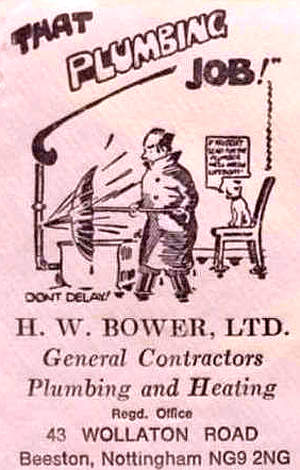
Henry & Harriett (née Wilds) Bower. as we shall see, he was to go on to make his name as a master plumber serving the people of Beeston and the wider area - often, as may be seen in a typical
advertisement - shown left - with a touch of humour at a difficult time.
His father, William Henry, was a son, the third child of William Bower who was born in about 1832 in Worksop, Notts2, who worked all
his life as a shoemaker3 and eventually married Mary Ann Cullum4 who
was about 16 years younger, born in Woolwich, Kent, a daughter of William Cullum, a shipwright and his wife, Hannah Ducker5. It appears
that she had joined her husband to be, originally as a servant to his busy household that often took in several boarders6. Their two
older children were born in about 1869 and 1873 before their marriage in June 1875 at St Stephens Church, Nottingham7 with William
Henry following in July 1881 and a daughter, Eliza, in about 1884. William died in 1895, followed by his wife Mary Ann in 18968.
Now essentially on his own, William Henry was left to make his own way in the world and he choose to set himself up as a hairdresser and, in 1906, married Harriett Wilds9,
who had been working as a dressmaker and boarding in Nottingham since at least 190110. In 1911 they were living and trading at 95 Robin
Hood Chase11, now with their son who, as we have seen, had been born in 1906. By 1912, they had moved to 385 Alfred Street North where
and, by 1916 had taken on a confectionary shop at 115 Mansfield Road while continuing with the hairdressing business at Alfred Street12.
By 1921, they had moved to live at 49 Grange Road, Woodthorpe and he had moved his hairdressing business to Sherwood Street, Nottingham while also continuing with their Mansfield Road business13.
It must have been a busy life that clearly stood as an example to their son, who was himself about to carve out a career for himself.
So it was that Horace decided to train as a plumber which would have required him to serve an apprentice and, in due course, he became a Registered Plumbing Contractor (RPC) and, by December 1930,
aged 24, he was set up in business, in conjunction with Alfred Newby Hassell, a Beeston-based plumber who had traded locally since 188714
and now traded with Horace as A N Hassell Ltd from premises at 9 Chilwell Road, Beeston15. It was to be a short-lived arrangement which
was formerly terminated in April 193216 and Horace continued trading from the family business premises at 115 Mansfield Road
in Nottingham – although, as we will see, he never lost his focus on Beeston as his preferred business base.
On 30 November 1933, at Addison Road Congregational Church, Nottingham, Horace married Edith Marie Chenery, the eldest daughter of Frederick Percy and Edith May (née Godfrey) Chenery17.
The best man was Thomas Joseph McMunn who, as ‘J McMunn’ was then working as a plumber alongside Horace but was to move on in February 193518.
The couple were to have one child, a daughter, born in 1939.
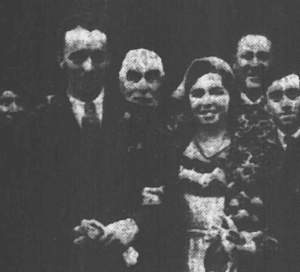 The couple (shown left at their wedding) made their first home at 30 Hall Croft in Beeston which, for the time being also served as the base for the plumbing business with a workshop at 13a Chapel Street,
Beeston19.
The couple (shown left at their wedding) made their first home at 30 Hall Croft in Beeston which, for the time being also served as the base for the plumbing business with a workshop at 13a Chapel Street,
Beeston19.
But this was a time when his plumbing business, helped by a highpoint in housebuilding in the Beeston area, was growing fast and he took a large part in council building in Attenborough and Toton and the
very active housebuilding development generally, in particular, the fast-growing Trentside Estate in Beeston Rylands20. This demanded a more
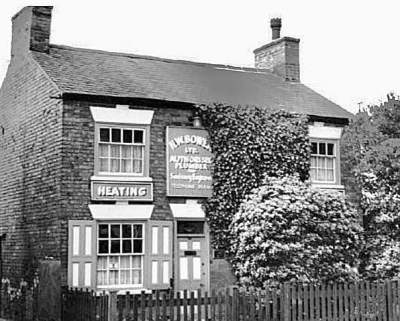
adequate and visible workshop, and this was found when he acquired a cottage at 43 Wollaton Road, Beeston (shown below left) which soon become something of a local landmark – as well as, for a year or two, the
home of Horace and his wife before they moved to their new family home at 220 Wollaton Road. Beeston.
 He was also gaining prestige in the plumbing industry as a whole. In April 1934, he had been appointed as an Examiner for registration examinations for the National Registration of Plumbers21.
And, in February 1937, he was appointed as Secretary to the Nottingham & Notts Council of the National Registration of Plumbers22.
He was also gaining prestige in the plumbing industry as a whole. In April 1934, he had been appointed as an Examiner for registration examinations for the National Registration of Plumbers21.
And, in February 1937, he was appointed as Secretary to the Nottingham & Notts Council of the National Registration of Plumbers22.
Socially too, he was also making great progress by taking a very active part in the local bowls world by providing trophies – including the Horace Bower Inter-County League Competition23
- holding office as well as playing competitively for local teams then and throughout the remainder of his life. In fact, his involvement in the game went much further afield. In February 1961, having already served
as the President of The Nottinghamshire Bowling Association, he was appointed as President of The Midland Counties Bowls Association24. Remarkably,
he represented his country against Ireland, Israel, South Africa and Australia25.
Despite the onset of war, Horace’s company kept well occupied and, in 1941 was advertising as having ‘branches at Nottingham & Daybrook’ as well as in Beeston26. In
January 1941 the business became a limited company, as ‘H W Bower Ltd’27. At its height it was employing 18 workers28.
Derek Cockayne who, it is believed, worked as foreman in the post-war years, is remembered by many.
In July 1948, William Henry Bower, Horace’s father died, aged 67, at Nottingham General Hospital. His busy life had continued into his later years when he had run the sub-postoffice and grocery shop
at 57 Wilford Crecent East in Nottingham29. His had been a busy life that, along with his wife, had undoubtably influenced their son to
apply himself to everything he did. He left an estate valued at £4,89330. In July of the following year, Harriett, his widow, died, aged 69,
in Beeston, having recently moved to live at 3 Beeston Fields Drive. She was buried in Beeston Cemetery31. Her estate was
valued at £6,53132.
For a while, Horace and his family moved to live at 3 Beeston Fields Drive but, by 1958, they had moved to 9 Glebe Street, Beeston and to 159 Wollaton Road, Beeston by 1968.
Horace's wife, Edith Bower died in February 1968, age 59, leaving an estate valued at £462133.
Horace went on to marry Joan Mellard Thompson in 196934. Joan was born in July 1923 and she had worked previously as a midwife35.
Sadly, their marriage was to be cut short when Horace died on 31 March 1972, in Beeston. He was cremated at Wilford Hill after a service at Beeston Parish Church36.
His estate was valued at £61,167 gross (£59,719 net)37, at the time, a sizable amount that reflected the value of his undoubtably successful business. It was soon to close and, sadly for many, its
headquarters building on Wollaton Road was demolished to make way for Lamorna Court, a block of 5 professional offices that stand there today.
It was the end of a remarkable era, driven by the energy of a remarkable man who is still remembered by many.
Notes
|
|