
© David Hallam - 2026
|
Well Known Beeston People from the Past -
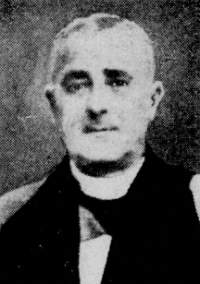 The Reverend John Paul Henry Halet (later Canon Halet)- was the Vicar of Beeston for almost 19 years which included the difficult period during and following the Second World War. He himself had an
eventful life which was not short of challenges which he handled head-on.
He was born in December 1890 1 in Mechelen (‘Malines’ in Dutch), a city which stands between Brussels and Antwerp in Belgium. His father, Emile Joseph Halet was born
in November 1838 in Belgium, married Laura Jeanne Deby (b. 1846)in Elsane, Belgium in August 1878 and they went on to have four children, a daughter and three sons, of which John Paul was the youngest
2. By the time of their marriage, Emile Joseph was serving as a Captain in the 11th Regiment of the Line and continued to serve up to his death in Belgium in September 1906, when John
Paul (the name we will use for convenience) was aged 16. His widow went on to live through the tragedy of the Great War but died in 1925 3.
But, well before the start of the Great War, while in his teens, John Paul had moved to England, probably to enable him to obtain an English education, first at Marlborough Collage and then at Keble College, Oxford where he graduated
as a Bachelor of Arts in 1913 and went on to Wells Theological College. In May 1914, he became a naturalised British subject 4 and, later that year, he was ordained Deacon
at Winchester Cathedral and was appointed as a Curate at St Marys Parish Church in Portsea 5, a position he kept until 1922, although, with the tragedy of the Great War
affecting everyday life, he contributed his part as an Army chaplain in France between 1916 and 1919 6. Despite this, during those years he continued his studies and, in
1917, he completed his Master of Arts degree from Oxford.
By 1922, he had become severely ill and went to Egypt to convalesce with the help of his former Army chief, Bishop Gwynne, and became an Assistant Chaplain at Cairo Cathedral until he was able to return to England in 1923.
He then became a Curate at St Andrews Church in Kingswood, Surrey for a short time and it was from here that, on 16 January 1924, he married Mabel Elreine Marshall, the second of seven children of the late Henry Miers Marshall and
his widow, Cecil Mabel Balfour Marshall.The service was held at the bride’s church, St Peters, Brimpton, Berkshire and was conducted by The Lord Bishop of Southwark, assisted by the Rev Alfred Marshall, the bride’s uncle, and the
Rev Clive Robertshire Pattison Muir, Rural Dean of Manchester and brother-in-law of the groom 7. Henry Marshall, the bride’s late father, had, in his working life,
been a successful Member of the London Stock Exchange although, some years before his death in August 1914, he had retired and the family were living at The Manor House, a grand mansion in Limpley Stoke, Wilshire, with the assistance
of seven domestic servants 8. In his will he left almost £50,000 (the equivalent of £7.5 million today), settled within the family with his widow as the executor.
9 By 1921, his widow and their three daughters – including Mabel – had moved to what was probably a more manageable home at Brimpton Lodge in
Brimpton, Berkshire, then with the assistance of just three domestic servants 10.
in 1925, John Paul was appointed Vicar of St Barnabas Church, Sutton, Surrey where he and his wife stayed for five years before moving to St Andrews Church, Catford, south-east of London. Then, in 1933, he became the Vicar of St Marks,
Surbiton, Surrey and they settled in the adjoining vicarage. Sadly, by about 1938, Mabel began to be ill, passed away on 20 January 1940, aged 42, and was buried in Surbiton Cemetery
11. They had no children.
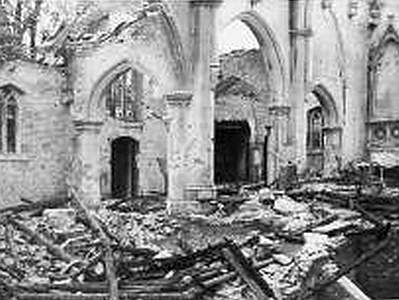 Then, on October 2nd, 1940, tragedy struck again when St Marks Church was largely destroyed by bombing (See right), as were the memorials in the churchyard although, amazingly, the spire remained standing. At the time, John Paul was in the
adjoining vicarage but, thankfully, that was not damaged. After this disaster, he was able to continue with Sunday services at the local boys’ school while using a room at the vicarage as a chapel on weekdays.
12
Then, in 1943, he came to Beeston – which was something of a ‘leap in the dark’ for him, given that until then he had held positions that were all south of London. Happily, it was to be a success all round.
Following Rev George Beresford leaving Beeston after seven years as Vicar, John Paul was inducted as Vicar of Beeston on 4 September 1943, by his long-time colleague, Bishop Barry of Southwell. For the next six years, he was to be
assisted, as Curate, by Rev Henry G Martin, who will still be remembered by some as a very pleasant and cheerful person, despite a difficult deformity of his foot.
This, of course, was a time when the war was at its height and everyday life – with blackouts, bombing, shortages and rationing – was restricted and often dreary. Nevertheless, the new Vicar, assisted by his enthusiastic and
well-liked Curate soon made his mark in the Parish.
During all his time at Beeston, John Paul lived in the old Vicarage, adjacent to the church, a fairly large building that would normally have been far too big for one person, especially someone with the responsibilities of the
Parish to handle – although it was also used for committee meetings, confirmation lessons, etc. and the large garden was the site for outdoor church events. Happily, though, he had reliable domestic help to keep things in order.
That was Edith Gibbs who had worked at the Vicarage in Surbiton and now continued to do so in Beeston 13.
At last, in 1945, peace came to Europe with VE-Day and Beeston folk were able to have a brief period of celebration before settling down to tackle the problems that were to continue during the years that followed. On the following
Sunday, an open-air Thanksgiving Service was held on Dovecote Lane recreation ground, led by the Vicar and Rev Iram G Wall for the Methodist Churches. As well as a fitting occasion, it was one that introduced the relatively new
Vicar to the local people generally.
In 1946, he was appointed Rural Dean which meant that he took on the added responsibility of overseeing the parishes in the area for the Bishop.
It was also in 1946 that he began an annual Christmas tradition in the Church which was to continue until about 1954. Each year members of the church, assisted by members of Sea Scouts and its sister group, the Sea Rangers put
on a Nativity Tableau in church following Evensong which required the erection of a stage in front of the chancel, complete with all the necessary equipment, including stage lighting, by the older scouts and rovers in the few hours
following the morning service. It was a popular annual event that, sadly, had to be discontinued after the Rangers were disbanded in 1953 and the Rovers (adult sea scouts) were also discontinued in 1954 and, as we will see there was
also an urgent need for repairs in the chancel area and elsewhere.
In September 1948, John Paul was appointed by the Bishop of Southwell, to be an Honorary Canon and to be the Bishop’s honorary chaplain.
 One of the organisations that was associated with Beeston Parish Church, was 2nd Beeston Sea Scouts, which had its headquarters in the old National School on Station Road as well as a base on the river Trent at Beeston. It had
been formed in 1928 as a ‘Controlled Group’ (i.e. overseen by the Parish Church) by the then vicar, Reverend Norman Phillips with Father Otway, a then enthusiast Curate at the church as its first scoutmaster. This connection with
the church meant that it had a monthly church parade and clergy tended to take an active interest in the activities of the scout group. John Paul was to maintain close contact with this scout troop and the local scout movement
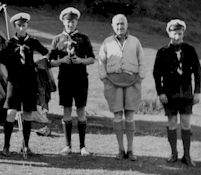
generally. In 1952, he even spent time with 2nd Beeston Sea Scouts at its annual camp in Rowen, North Wales (see left, surrounded by Bernard Highton, Fred Thraves and Brian Underwood). In the following year, he was appointed
Vice-Chairman of the South-West Notts Scout Association and, by 1955, he was its President. Click here to see more of his interest in the scout movement.
The Valley Mission, the satellite church on Queens Road, had been built to serve the residential area that had grown around the Humber Works by the end of the 19th century. This was still operating when, in October 1952, it was
joined by St Marys, then consecrated as a new sister church that had been built to serve Beeston Rylands. By this time, the workload for the Vicar was such that two Curates worked alongside him and alterations to the Vicarage
were made to house them.
Also by 1952, it had become clear that repairs to the Church, including to the heating, chancel roof and unsafe bells, which had been identified for some years but had been delayed by the war years and its aftermath, were now
urgently required. To address this, a Beeston-wide appeal was made with a target of £9000. In the event, the needed cash was slow to come in – only £615 had been donated by the end of the first eight months
but it seems that, one way or another, enough money was raised as most of the work was completed over the next few years.
The cost of a new roof to the chancel, together with repairs to the adjacent brickwork was paid for by the local council as it had inherited the ancient obligation to do so when it purchased Beeston Fields Farm
14. The cost was £1,400 which was approved by the council in April 1953 15.
By about 1956, John Paul’s health began to show difficulties, apparenthy with heart problems, and, in 1957, despite some signs that health was beginning to improve, he resigned from his position as Rural Dean, and the heavy work and responsibilities that came
with it. Sadly, in March 1962, his poor health was again such that he relinquished his position and left Beeston after almost 19 years of service there, to take up the less arduous position as Priest-in-Charge at the nearby parish of Old Clifton & Glapton
16.
Sadly, he died there on 23rd February 1963, aged 72. His funeral service at Beeston Parish Church was very well attended and was followed by cremation at Wilford Hill17.
His estate was valued at £13,208. After instructions to dispose of some personal chattels, the majority was left to Edith Gibbs, who had served him faithfully as his housekeeper for many years
18.
Canon Halet had served Church life and other associated activities in Beeston, well through the difficult years during and following the second world war. It was never going to be easy, but thankfully, he was able to bring the
depth of his personal history to ensure that progress was made.
As his oldest personal friend, Southwell Bishop Barry said at his funeral, “You in Beeston took him to your hearts and gave him your friendship and support. He made a great contribution to the revival and re-strengthening of
the Church in Beeston and ministered here with great fruitfulness”.
Notes
|
|